One day beyond Osaka · Look closely, leave room
Nara from Osaka: A Temple-and-Park Day, Not a Two-City Race
Choose a Nara day instead of Kyoto or another Osaka outing. Plan around Todaiji, a short park walk and a meal, with station choices, deer etiquette and budget checks.
TripCompass AI editorial guide · Sources reviewed
Original guide: https://tripcompass.ai/itinerary/osaka-to-nara-temple-park-day/
The useful bits
- Replace an Osaka day; do not combine Nara and Kyoto
- Make Todaiji the main visit and the park walk adjustable
- Watching deer does not require feeding or touching them
Give Nara a reason, not a spare slot
A temple you want to see, a little time outdoors and a meal before heading back. This day is for travelers staying in Osaka who would rather look closely at one part of Nara than collect another city in a hurry.
The official Nara Park area guide places temples and free-roaming deer within a broad park area. Treat that as a reason to choose a small section, not evidence that every sight belongs on one walking circuit. This is an editorial plan based on official information, not a firsthand review or a timed tour.
Who this page is for
Choose this if Todaiji’s Great Buddha Hall interests you and the group wants some outdoor time. It can fit a couple, friends with a shared interest in architecture, or a family willing to adjust the day to everyone’s walking and rest needs. It is not automatically the easiest family option simply because there are deer.
If animals make someone uneasy, do not promise a deer-free route through the park. If the real priority is shopping, another meal in Osaka or a particular Kyoto place, honor that instead. Use the Osaka or Kyoto day-choice guide to compare the alternatives.
Nara, Kyoto or another Osaka day?
| What you want from the day | Choose | What you give up |
|---|---|---|
| Todaiji and a small amount of park time | Nara, with one main visit and a flexible return | Kyoto and the full Umeda shopping day |
| A specific Kyoto place matters most | One Kyoto area | Nara, rather than fitting it after lunch |
| Food, shopping and an easy return to the hotel | Stay in Osaka | A second city’s sightseeing |
| More sightseeing despite a tired group | Reconsider the outing together | The idea that a spare day must be filled |
Do not combine Nara and Kyoto in this day plan. The choice is about what deserves your attention, not which city has the shortest quoted train journey.
Suggested trip length and what to replace
Use one full middle day of a 4-day, 3-night Osaka trip. In the base Osaka itinerary, replace Day 3’s Umeda plan or Kyoto alternative. Do not keep either one and attach Nara afterward.
This is a flexible day allocation, not a claim that sightseeing takes a fixed number of hours. Allow for the hotel-to-station journey, onward movement in Nara, a meal, rests and the return. Keep the Osaka evening loose. Arrival and departure days are not reliable substitutes for this full day.
If a theme park already uses the other full day, decide whether you still want a Nara outing more than time in Osaka itself. A shorter trip may be better served by leaving Nara for another visit.
Choose the station before buying a pass
The official travel-to-Nara overview distinguishes Kintetsu-Nara / 近鉄奈良 from JR Nara / JR奈良. They are different stations. Keep the full station name in your plan rather than saving only “Nara.”
For an Osaka-Namba base, investigate the Kintetsu route; compare JR options against your actual hotel and onward route rather than assuming one operator is best for everyone. Confirm services, changes, fares and any train-specific ticket requirements with the operator for your travel date. No pass saving or fixed travel time is established here.
Todaiji’s access guide is a starting point for the journey from the station to the temple. Decide whether the approach suits the group on foot or needs a current local transport option. A short-looking line on a map is not proof of a step-free route, available transport or an effortless walk.
A small day in four parts
1. Arrive with the main visit already chosen
Save Todaiji / 東大寺 and Great Buddha Hall / 大仏殿. Check the temple’s visitor and admission information for the places you actually want to enter. Seeing the park and entering a hall are different parts of the outing; do not assume one admission covers every hall or the museum.
Before setting out from the station, agree on a return plan and a first rest point using current maps and facilities. This article is not turn-by-turn navigation, and it has not tested a specific walking sequence on site.
2. Let the Great Buddha Hall be the main event
The temple’s Daibutsu-den introduction explains the hall and its Great Buddha. Read a little before arriving so the visit has a focus beyond taking a picture.
Choose one looking question: how does the scale feel as you approach, what do you notice about the roof and timber, or what detail stays in your mind after leaving? These are our observation prompts, not a temple activity or an invitation to touch, sketch or photograph anything. Follow posted worship, access and photography rules, and keep circulation paths clear.
You do not need to add every hall to justify the trip. If the main visit is unavailable, reassess whether the park alone is worth the journey before leaving Osaka; do not replace it with a chain of unplanned admissions.
3. Give lunch and sitting down their own place
Choose a meal around your actual route, checking current operation, menu needs and seating. No restaurant or seat has been verified for this guide. Set a queue limit together and switch plans if it is exceeded.
Over the break, each person can name one detail they would describe to a friend. It is a small way to notice different interests, without buying a souvenir or turning the day into a quiz.
4. Add a short park look, then decide whether to return
Keep the park portion near the route you have checked. You do not need a full park circuit, a close-up deer photo or an encounter at a particular spot. If the approach already provided enough outdoor time, skip another loop.
Left out on purpose: a required second temple area, hill climb, Naramachi shopping circuit and Kyoto transfer. Those may be subjects for a different day, not obligations after the meal. Finishing early enough to rest in Osaka is a valid outcome.
Deer are not a required hands-on activity
Nara’s deer are wild animals, not pets. The official deer guidance warns against teasing or grabbing them, limits feeding to the designated shika senbei crackers and stresses keeping paper and plastic away from them.
Our default for this course is simply watching from a distance. Keep children with their accompanying adult; do not pressure anyone to feed or pose with an animal. If you choose to feed, follow current local instructions and do not use human snacks. Feeding is optional, not an entry requirement or a guarantee of a calm encounter.
Keep food and loose belongings secure, and do not follow deer for a photograph. If the group is uncomfortable, change the plan and seek local staff guidance. This page does not guarantee animal behavior, a deer-free path or a risk-free family outing.
When to shorten or cancel the outing
| What changes | Adjust the plan | Do not rely on |
|---|---|---|
| Rain, heat or severe weather | Reassess the outdoor approach and park time; stay nearer the hotel when appropriate | The temple hall making the whole journey indoors |
| The main hall cannot be visited | Decide whether a park visit alone is genuinely wanted | Another hall being open or equivalent |
| Tired legs or an uneasy companion | Drop the extra loop and reconsider the return route | Completing the map to get value from a ticket |
| Transport disruption | Check operator notices and local instructions before setting out or returning | A tightly reserved Osaka dinner or a fixed last-train assumption |
Confirm toilets, stairs, rest points and access requirements for the actual route with the relevant facilities. Verify luggage arrangements before relying on them. This guide is not a weather forecast or an accessibility assessment.
Budget considerations
Keep flights and the same three Osaka hotel nights fixed when comparing this day with the alternatives. Then list only the costs that change.
| Item | What to compare |
|---|---|
| Intercity travel | Actual outward and return services, including any required additional ticket |
| Local movement | Station-to-temple and return connections you expect to use |
| Admission | The chosen hall and any genuinely wanted extra, not every possible ticket |
| Food and rest | A similar meal budget in each city; do not count lunch twice |
| Changes and purchases | Lost reservations and optional shopping; neither should force a longer outing |
No current fares, admission prices or pass discounts are quoted. Check ticket validity and change conditions yourself. The Japan travel budget guide helps separate individual expenses from shared room costs.
Put it into your Kansai trip
Return to the Osaka 4-day itinerary and choose just one Day 3. Compare Osaka versus a Kyoto day, or keep the trip city-based with a Doguyasuji tableware-and-food-model half-day. The English AI finder suggests cities; it does not confirm this route, admission or an animal encounter.
These links open generic searches for an Osaka hotel base or Nara activities. They are not Todaiji admission links, confirmed day tours or an endorsement of a provider. Check meeting points, transport, inclusions and cancellation terms on the destination site.
Sources and review scope
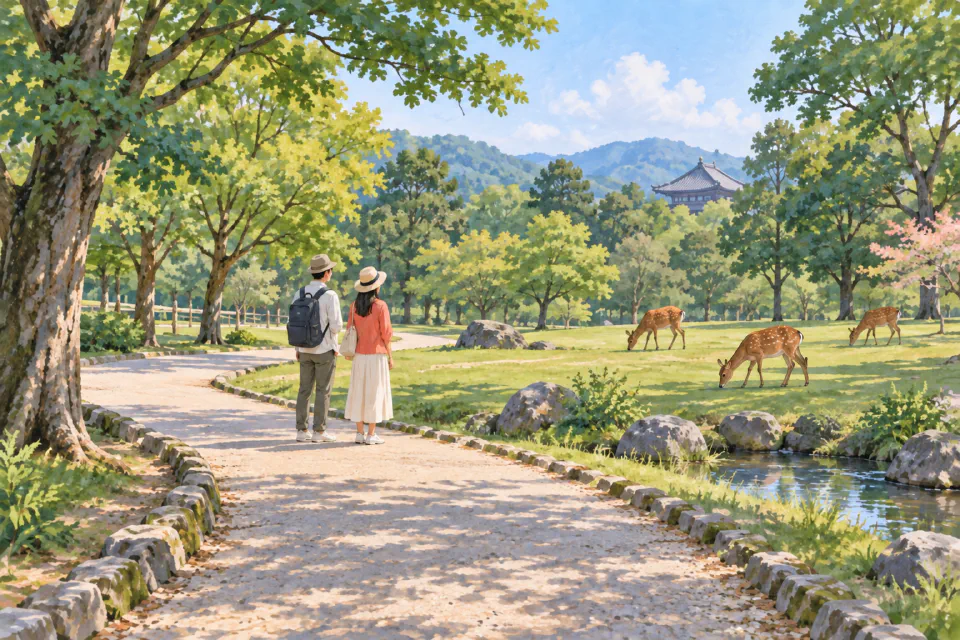
The six official pages linked above were reviewed on 22 September 2026 for area context, station identity, temple visitor information and deer etiquette. The sequence, looking prompts and omissions are editorial choices. We have not tested the route or verified travel-date transport, opening, tickets, meals or facilities. The cover is a newly generated, imagined Nara-inspired illustration, not a photograph or an accurate map of the park or temple.
Verify current prices, opening hours, visa rules, availability and booking terms before traveling or booking. This guide provides no live quote or safety, entry or booking guarantee.